Oxbow Carbon LLC Increases RPS Productivity by 82% with Export On-Demand

oxbowOxbow Carbon LLC needed a solution to help to transport and sell the petroleum products they create into markets where they could be used to produce aluminum, steel, and other critical products for the world economy. Oxbow signed on with for Amber Road’s Export On-Demand solution late last year, and the company has already increased its restricted party screening productivity by 82 percent.

Now, Oxbow is able to centralize and automate its export compliance processes across 90 countries and screen against over 250 lists. Using Amber Road’s hosted technology, Oxbow consolidated 13 ERP systems into one common database portal, creating a simplified and efficient trade compliance process.

“We were looking to improve efficiency and productivity on our old RPS model. We looked at Amber Road’s Export On-Demand solution as a way to achieve those productivity gains and significantly reduce manual effort,” said Louis Lisowski, director of compliance, Oxbow Carbon LLC. “Not only did the software meet our requirements, the implementation phase of the project was 75 percent under the budgeted implementation costs.”

Read more about Oxbow’s use of Amber Road solutions here.

EmailPrintFacebookTwitterDeliciousDiggEvernoteGoogle+LinkedInPinterestRedditStumbleUponTumblrBookmark/FavoritesShare

Take Advantage of Free Trade Agreement Benefits

Manufacturers can spend almost 50 percent of revenue on purchasing parts alone, which places low-cost sourcing at the top of any business strategy. To maximize your company’s savings, look no further than free trade agreements (FTAs).

FTAs allow your company to source from countries that have agreed to reduce their export duties with whatever country you are trading from, in turn reducing your landed costs.

Navigating these agreements can be tricky, however. You’ll often need a certificate of origin, as well as a Trade Program certificate, to prove a claim. You may also want the ability to compare your potential savings from several vendors as part of a multi-sourcing strategy. Lost already? Check out these 5 tips for using FTAs in your supply network, from Amber Road’s VP of Global Trade Content Anthony Hardenburgh.

“Armed with the right process and supporting technology, your company can achieve the next level of low cost country sourcing in your global operation,” Hardenburgh notes. Indeed, automating the FTA process can reward your company with significant savings and save you more than a few documentation headaches.

Has your organization taken advantage of an FTA to reduce your landed cost?

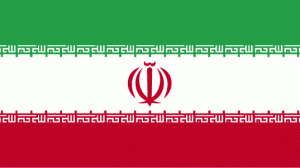
US Senate Unanimous in Vote for Tougher Sanctions Against Iran

On November 30, 2012, the United States’ Senate passed the Menendez amendment (SA 3232) adding stronger Iran sanctions to the National Defense Authorization Act. Key features of the amendment, drafted by Senators Robert Menendez, Mark Kirk, and Joe Lieberman, according to Robert Menendez’ website, are that it:

  • Designates Iran’s energy, port, shipping, and ship-building sectors as entities of proliferation due to the role they play in supporting and funding Iran’s proliferation activities
  • Imposes sanctions on persons selling or supplying a defined list of commodities to Iran – commodities that are relevant to Iran’s ship-building and nuclear sectors such as graphite, aluminum, steel, metallurgical coal and software for integrating industrial processes
  • Designates the Islamic Republic of Iran Broadcasting entity and its President as human rights abusers for their broadcasting of forced televised confession and show trials

It adds that:

To address concerns about access to humanitarian goods in Iran there are exceptions for the provision and sale to Iran of food, agricultural commodities, medicine, medical devices and other humanitarian goods AND the amendment imposes new human rights sanctions on those in Iran who are engaged in corruption or the diversion of resources related to these goods and that are preventing them for [sic] reaching the Iranian people.

Responding to the Senate’s vote in favor of the amendment (by 94-0), Menendez said, “I applaud my colleagues…for joining us in sending a clear message to Iran: you can’t just try to wait us out. The waiting game is over and, in the end, one way or the other, Iran will not be allowed to acquire a nuclear weapon with which to threaten the United States, Israel, the region, and the world.”

Michael Burton, partner at the law firm Arent Fox and co-chair of the American Bar Association’s (ABA) Export Controls and Economic Sanctions Committee said:

“The Senate has yet to pass the NDAA, but as they obtained closure on December 3, the vote on final passage may occur soon. And then the House must agree to it – it’s possible a conference would have to be convened – so passage isn’t a sure thing yet.”

Source: http://www.worldecr.com/news

Understanding the Recent Ruling on Conflict Minerals

Existing Global Trade Management and Supply Chain Technology will need to Adapt to these Regulations

The US Securities and Exchange Commission (SEC) has proposed regulations that require US and certain foreign companies to report the use of “conflict minerals” from the Democratic Republic of the Congo (DRC) or adjoining countries in their products.

Conflict minerals are mined under conditions of armed conflict and human rights abuse. Areas notably affected are in the eastern parts of Africa, where various armed rebel groups within the DRC are largely responsible for using these natural resources to finance continued fighting, but neighboring countries such as Burundi, Rwanda and Uganda have also profited significantly. Conflict minerals mined in the DRC are typically passed through various intermediaries before being finally purchased.

At present, four minerals are listed as conflict minerals:

  • Columbite-tantalite, or commonly known as Coltan – used primarily in the production of capacitors, hearing aids, pacemakers, airbags, GPS, ignition systems, anti-lock braking systems, laptop computers, mobile phones, video game consoles, cameras, etc.
  • Cassiterite – used in production of tin, a common component of biocides, fungicides, high performance paint manufacturing, etc.
  • Wolframite – an important source of tungsten, used in fishing weights, dart tips and golf club heads, in addition to use in other metalworking tools.
  • Gold – used in jewelry, electronics and dental products.

In practical terms, what does this ruling mean for companies whose products use these minerals? According to the National Retail Federation, the regulations will apply not only to manufacturers but also to retailers considered to be “contracting to manufacture” private-label merchandise.

A retailer simply placing its brand on a generic product would not be covered, but those that have “some actual influence over the manufacturing of that product” would be covered, NRF explained. Retailers selling only third-party merchandise under the product’s own brand rather than the store’s brand are not affected. Companies are able to avoid the disclosure rules if they use recycled or scrap minerals.Companies will have until May 31, 2014, to make their first disclosures about whether the minerals they use are “conflict free,” meaning they did not finance or benefit armed groups in Central Africa. And for two years — four years for smaller firms — companies will be able to disclose simply that they could not determine whether the minerals were helping to finance fighting in the DRC.

Final Thoughts

Existing global trade management and supply chain technology will need to adapt to these regulations. Here are some initial steps companies can take to ensure they are ready for compliance in 2014:

  • Ensure that your source of global trade content lists sanctions against the conflict mineral countries and the minerals themselves.
  • Consider using questionnaires or surveys to determine whether your product suppliers are obtaining minerals from conflicted areas. Much the same way that suppliers certify eligibility for preferential duty treatment, they can also certify that their products do not contain conflict minerals.
  • Perform admissibility reviews on transactions that contain the minerals or products made with the minerals.
  • Update your standard operating procedures to include processes for requesting and capturing declarations from suppliers and for performing transaction reviews.


The Importance of Global Trade Content for Managing Free Trade Agreements

Users also need to Understand the Trade Content that Powers their Solutions

On May 14, 2012, President Obama signed the presidential proclamation that put the US-Colombia free trade agreement into force. Designed to promote the flow of certain goods and services between the countries, the free trade agreement was years in the making.

According to the Office of the US Trade Representative (USTR), the tariff reductions in the Agreement will expand exports of US goods alone by more than $1.1 billion, supporting thousands of additional American jobs. The ITC also projected that the Agreement will increase US GDP by $2.5 billion. The Agreement will remove significant barriers to US goods from entering Colombia’s market, as over 80 percent of US exports of consumer and industrial products to Colombia will become duty free immediately, with remaining tariffs phased out over 10 years.

Because the agreement specifies changes in rules of origin and HS codes, it is critical that any organization using global trade management software ensure that its vendor made the appropriate updates to the underlying trade content and put them in place immediately. In fact, the US-Colombia FTA is affecting over 20,000 HS codes and over 800 rules of origin. This is a significant amount of content that required collection, analysis and interpretation so that it could be implemented in conjunction with the president’s signature.

Especially for organizations already doing business with Colombia, the FTA could mean substantial reductions in landed costs due to preferential treatment as of the effective date. Supply chain managers should be able to run scenarios that reflect preferential rates as they make sourcing decisions that may now include items from Colombia.

Don’t be afraid to speak with a representative from your GTM software vendor. Find out whether it anticipated the formalization of the agreement with the necessary updates to its trade content. You may also want to ask about how many trade specialists are on staff to monitor government information feeds from around the world as trade regulations change. Those specialists should have extensive backgrounds in compliance and global trade, as well as speak the languages of their countries of expertise.

Final Thoughts

GTM software users need to understand the importance of the trade content that powers their solutions and the critical role it plays in areas like free trade agreement management. As countries continue to expand the scope of these preferential programs, choosing a GTM vendor that offers both depth and breadth of trade content will become even more critical.