Brown-Forman Grows its Spirited Exports Program with Amber Road

It may be hard to believe that one of the world’s largest producers of wines and spirits once lacked visibility of its ocean shipments and carrier performance levels. But back in 2004, Brown-Forman had to rely on the tracking systems of individual carriers to keep tabs on product in transit, with no single platform to monitor the movement of popular brands like Jack Daniel’s, Southern Comfort, and Korbel.

Brown-Forman began looking for a software suite that could provide a central repository while navigating the highly regulated alcoholic beverage industry, where strict records are essential. The company picked Amber Road (then Management Dynamics).

Brown-Forman quickly gained some unsettling insights into its supply chain. For example, the company had thought its distributors were taking between three and five days to clear their goods and get them unloaded. However, it sometimes took up to 10 days. With Amber Road’s solution, the company was able to determine when its containers were being released to customers.

“It has helped us to secure our supply chain, giving us visibility from beginning to end,” says Sherree Hockensmith, International Transportation Manager at Brown-Forman. “We now have tools to slice and dice our data anyway we need to.”

The company now knows great deal about the actual services levels it receives from its carriers, and can track its containers from production facilities in Kentucky and Virginia all the way to destination.

To find out more about Brown-Forman’s success with Amber Road, please read this SupplyChainBrain feature.

EmailPrintFacebookTwitterDeliciousDiggEvernoteGoogle+LinkedInPinterestRedditStumbleUponTumblrBookmark/FavoritesShare

Don’t Miss Amber Road’s Retail Seminar: Financial Returns in Global Trade

Retail-Seminar-Box0

Please join Amber Road and Sandler & Travis Trade Advisory Services, Inc. for a free seminar specifically addressing retailers and Financial Returns in Global Trade.

Learn how your peers have improved the efficiency of their import operations to respond to rapid shifts in consumer behavior and grow their business outside the U.S. Speakers will address strategies for delivering financial returns on your global retail supply chain.

Don’t miss out on this FREE seminar for retailers in NYC!

What: Retail Seminar: Financial Returns in Global Trade - Lunch is included, Networking Reception to Follow.
When: April 17, 2013, 10am – 7pm
Where: Gansevoort Park Avenue NYC
420 Park Avenue South, Between 28th and 29th Streets (Conveniently located between Penn Station and Grand Central)
New York, NY 10016
.
After a full day of sessions, attendees will enjoy a networking reception at this luxury urban resort in midtown Manhattan. Register to reserve your spot today!

Executive Spotlight: Ty Bordner

The Executive Spotlight series will feature several of Amber Road’s key thought leaders as they discuss what they see as the biggest challenges and trends in the GTM space.

What do you believe to be the key challenges facing your customers and their supply chains in the year ahead?

As supply chains continue to expand globally, customers will face new challenges. Whether a small to medium company looks to expand globally for the first time or a large multi-national accesses a new geographic region, the value equations are similar.

As an example, retail customers often seek the ability to optimize against total landed cost before executing on a quote. They want to understand their all-in costs up front, and then measure against those costs on the back-end to in order to gauge accuracy and create self-improvement. In addition, they want to allocate these costs across products and/or divisions. With GTM software, they can optimize the quote when the elements like global logistics costs and duties, taxes, and fees are added to the calculations. These costs, via electronic invoice receipt, can be validated automatically and reconciled by the GTM software. This type of automation and integration of trade content creates value by allowing the importer to make better, more optimal buying decisions upfront and allowing for automatic validation and payment on the back-end, including the allocation of bulk costs to an individual product line if required. This type of information flow creates a more accurate picture of the overall cost structure of a given product and will help the importer manage their overall profitability moving forward.

Another example concerns helping customers move their goods through customs at a quicker pace. The most prevalent delay at customs is incomplete or inaccurate paperwork. A GTM software solution that provides the proper toolset will allow standard documents to be created and/or modified to meet the specific requirements of the importing customs regime. For instance, Brazilian customs require a breakdown of product components to be printed on the customs invoice for certain commodity types, whereas other countries do not require that level of detail. With a configurable GTM system, the customs invoice can be generated in the context of the importing country. The proper component detail will show in Brazil, allowing those goods to move through customs without delay. Since it is common for customs delays to last anywhere from a week to a couple of months, the value created in this example is reduced Days Sales Outstanding (DSO) as well as increased customer satisfaction.

These are just a few examples in a world of many. The bottom line is that trading globally creates an entire new set of issues. Moreover, these issues and challenges continue to change on a dynamic basis; what was the rule today may not be the rule tomorrow. GTM software creates value by helping to address these kinds of issues in a systemic and automated way.

How can supply chain, as a function, better align with a company’s broader strategy?

The supply chain should be flexible enough such that it can be tuned to align with company goals. Nobody wants to be locked in to a rigid and inflexible supply chain, especially in the global world where the business complexity and economic stakes are often higher than in the domestic world. Of course, company goals may change over time due to overall economic climate or change in direction at the executive level. A company may decide to move from a customer service-oriented supply chain to a low-cost, no fringes supply chain or vice versa. Having an execution platform that is flexible enough to be easily configured to meet the desired overall business strategy is a powerful tool. A highly configurable GTM supply chain execution platform creates a solid foundation from which a company can perform and, more importantly, provides the insurance to meet the dynamic requirements of a rapidly changing global business world.

Ty Bordner is the Vice President of Product Management and Solutions Consulting at Amber Road and has over 18 years of experience in the GTM software market. He is responsible for both product strategy and direction, as well as customer and prospect focused solution creation.

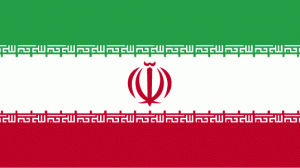
US Senate Unanimous in Vote for Tougher Sanctions Against Iran

On November 30, 2012, the United States’ Senate passed the Menendez amendment (SA 3232) adding stronger Iran sanctions to the National Defense Authorization Act. Key features of the amendment, drafted by Senators Robert Menendez, Mark Kirk, and Joe Lieberman, according to Robert Menendez’ website, are that it:

  • Designates Iran’s energy, port, shipping, and ship-building sectors as entities of proliferation due to the role they play in supporting and funding Iran’s proliferation activities
  • Imposes sanctions on persons selling or supplying a defined list of commodities to Iran – commodities that are relevant to Iran’s ship-building and nuclear sectors such as graphite, aluminum, steel, metallurgical coal and software for integrating industrial processes
  • Designates the Islamic Republic of Iran Broadcasting entity and its President as human rights abusers for their broadcasting of forced televised confession and show trials

It adds that:

To address concerns about access to humanitarian goods in Iran there are exceptions for the provision and sale to Iran of food, agricultural commodities, medicine, medical devices and other humanitarian goods AND the amendment imposes new human rights sanctions on those in Iran who are engaged in corruption or the diversion of resources related to these goods and that are preventing them for [sic] reaching the Iranian people.

Responding to the Senate’s vote in favor of the amendment (by 94-0), Menendez said, “I applaud my colleagues…for joining us in sending a clear message to Iran: you can’t just try to wait us out. The waiting game is over and, in the end, one way or the other, Iran will not be allowed to acquire a nuclear weapon with which to threaten the United States, Israel, the region, and the world.”

Michael Burton, partner at the law firm Arent Fox and co-chair of the American Bar Association’s (ABA) Export Controls and Economic Sanctions Committee said:

“The Senate has yet to pass the NDAA, but as they obtained closure on December 3, the vote on final passage may occur soon. And then the House must agree to it – it’s possible a conference would have to be convened – so passage isn’t a sure thing yet.”

Source: http://www.worldecr.com/news

Understanding the Recent Ruling on Conflict Minerals

Existing Global Trade Management and Supply Chain Technology will need to Adapt to these Regulations

The US Securities and Exchange Commission (SEC) has proposed regulations that require US and certain foreign companies to report the use of “conflict minerals” from the Democratic Republic of the Congo (DRC) or adjoining countries in their products.

Conflict minerals are mined under conditions of armed conflict and human rights abuse. Areas notably affected are in the eastern parts of Africa, where various armed rebel groups within the DRC are largely responsible for using these natural resources to finance continued fighting, but neighboring countries such as Burundi, Rwanda and Uganda have also profited significantly. Conflict minerals mined in the DRC are typically passed through various intermediaries before being finally purchased.

At present, four minerals are listed as conflict minerals:

  • Columbite-tantalite, or commonly known as Coltan – used primarily in the production of capacitors, hearing aids, pacemakers, airbags, GPS, ignition systems, anti-lock braking systems, laptop computers, mobile phones, video game consoles, cameras, etc.
  • Cassiterite – used in production of tin, a common component of biocides, fungicides, high performance paint manufacturing, etc.
  • Wolframite – an important source of tungsten, used in fishing weights, dart tips and golf club heads, in addition to use in other metalworking tools.
  • Gold – used in jewelry, electronics and dental products.

In practical terms, what does this ruling mean for companies whose products use these minerals? According to the National Retail Federation, the regulations will apply not only to manufacturers but also to retailers considered to be “contracting to manufacture” private-label merchandise.

A retailer simply placing its brand on a generic product would not be covered, but those that have “some actual influence over the manufacturing of that product” would be covered, NRF explained. Retailers selling only third-party merchandise under the product’s own brand rather than the store’s brand are not affected. Companies are able to avoid the disclosure rules if they use recycled or scrap minerals.Companies will have until May 31, 2014, to make their first disclosures about whether the minerals they use are “conflict free,” meaning they did not finance or benefit armed groups in Central Africa. And for two years — four years for smaller firms — companies will be able to disclose simply that they could not determine whether the minerals were helping to finance fighting in the DRC.

Final Thoughts

Existing global trade management and supply chain technology will need to adapt to these regulations. Here are some initial steps companies can take to ensure they are ready for compliance in 2014:

  • Ensure that your source of global trade content lists sanctions against the conflict mineral countries and the minerals themselves.
  • Consider using questionnaires or surveys to determine whether your product suppliers are obtaining minerals from conflicted areas. Much the same way that suppliers certify eligibility for preferential duty treatment, they can also certify that their products do not contain conflict minerals.
  • Perform admissibility reviews on transactions that contain the minerals or products made with the minerals.
  • Update your standard operating procedures to include processes for requesting and capturing declarations from suppliers and for performing transaction reviews.